
On a solo motorcycle, two people can ride, no more. The rule seems simple, but it becomes complicated as soon as you add a sidecar or transport a child. The number of authorized passengers primarily depends on what is listed on the vehicle’s registration document, and not on the physically available space on the seat or in the sidecar.
Registration Document and Homologation: The Only Reference That Counts
It is often believed that a motorcycle can carry two people by default. In practice, the number of seats listed on the registration document sets the legal limit. A homologated three-seat sidecar allows for a driver and two passengers. A model homologated for two seats permits only one passenger, even if the sidecar appears large enough to accommodate more.
Article R311-1 of the Highway Code specifies that adding a sidecar to a motorcycle does not change its classification. The motorcycle remains categorized as L3e or L4e. The mention “SOLO/SIDE-CAR” or “SIDE-CAR” on the registration document indicates whether the sidecar can be easily removed or if it is integrated into the chassis. To better understand the number of passengers on a motorcycle with or without a sidecar, the registration document remains the reference document.
When the sidecar can be removed without significant modification to the frame, the registration document states “SOLO/SIDE-CAR.” When the wheelbase, braking system, or chassis has been modified, the mention changes to “SIDE-CAR,” and the vehicle must undergo a new homologation before it can be driven.
Solo Motorcycle: Adult Passenger and the Special Case of a Child
On a motorcycle without a sidecar, the rule is clear: one driver and one maximum passenger. The passenger must have a seat, footrests, and hand grips. Without this equipment, transporting someone is prohibited, even for a short distance.
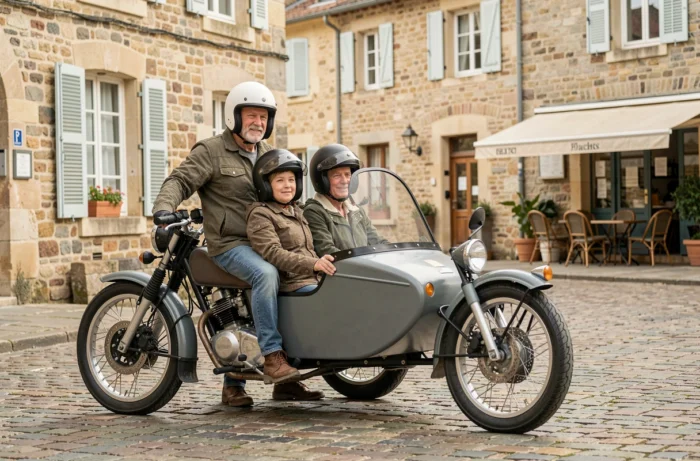
For a child, the Highway Code imposes a minimum age of five years. Below this age, transport is prohibited unless in a sidecar equipped with a seatbelt or an approved restraint system. The sidecar then becomes the only legal option for taking a child under five years old.
A point confirmed by field feedback: even above five years old, a child who cannot reach the footrests is not safe. The regulatory framework sets a minimum standard, but the driver’s responsibility goes beyond mere administrative compliance.
Mandatory Equipment for Sidecar Passengers
The passenger seated in the sidecar is subject to the same obligations as the driver regarding one central point: wearing an approved helmet is mandatory, unless the sidecar has a seatbelt and an approved closed structure (a rare case, limited to certain manufacturer models).
Here are the elements to check before hitting the road with a passenger in the sidecar:
- CE-approved helmet worn and fastened, for the driver as well as for each passenger.
- Updated registration document mentioning the sidecar configuration and the number of authorized seats.
- Appropriate restraint device if a child under five years old is traveling in the sidecar.
- Total width of the vehicle compliant with regulations (not exceeding the limit set by Article R312-10 of the Highway Code).
Sidecar and Significant Modification: When Homologation Changes
Attaching a sidecar to a motorcycle is not just about bolting a sidecar onto the frame. As soon as the operation modifies the chassis, wheelbase, braking system, or weight distribution per wheel, it falls into the category of significant modifications. The vehicle must then undergo a new homologation with the DREAL or an equivalent service.
In practical terms, this means that any modification to the technical specifications on the registration document triggers this obligation. A second-hand sidecar purchased and mounted without updating the registration document exposes the driver to a violation, as well as a refusal of coverage by the insurance in case of an accident.

Accident with Overloaded Passengers: What Insurance Covers
Riding with more passengers than authorized seats is not just a violation. In the event of an accident, the insurer may invoke an exclusion of coverage for non-compliance with the vehicle’s usage conditions. The driver then finds themselves solely responsible for material and bodily damages.
For injured passengers, the situation is different. The law of July 5, 1985 (Badinter law) protects non-driving victims. Even in the case of overload, an injured passenger is entitled to compensation, unless there is gross negligence that constitutes the exclusive cause of the accident, a notion interpreted very restrictively by the courts.
This creates a significant asymmetry:
- The driver potentially loses all insurance coverage for the damages they suffer.
- The overloaded passenger remains compensated in almost all cases, thanks to the Badinter law.
- Damages caused to third parties are covered by mandatory civil liability, but the insurer can then seek recourse against the at-fault driver.
Overloading passengers on a sidecar or motorcycle is therefore never a trivial risk, even if “it fits” physically. The registration document remains the reference document, and each additional unapproved seat worsens the driver’s legal situation in the event of a check or an accident.