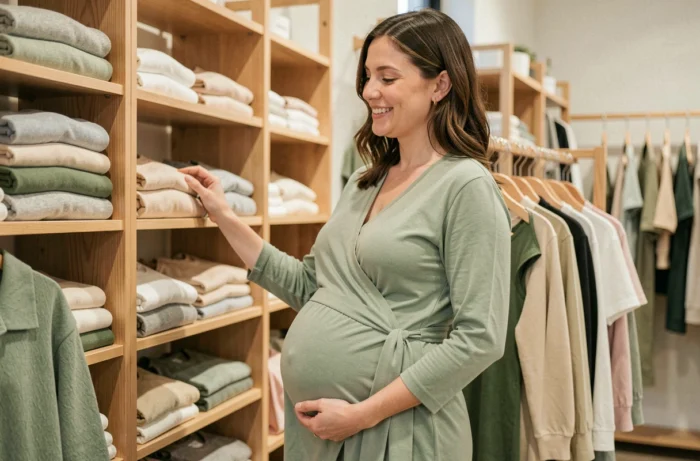
Your belly starts pressing against the waistband of your jeans, your bra feels a little tighter each week, and your favorite dress no longer hangs the way it used to. These signals from your body are a better guide to when it’s time to rethink your wardrobe than the pregnancy calendar. Choosing maternity clothes that combine comfort and style comes down to a few practical considerations: fabric, fit, and when each piece will come in handy.
Fabric and breathability: what the right fit alone can’t solve
Have you ever noticed that a loose T-shirt can feel warmer than a fitted linen top? A garment’s looseness doesn’t guarantee thermal comfort. During pregnancy, the body produces more heat, and the NHS recommends loose-fitting natural fibers for their absorbency and breathability.
Cotton, linen, and Tencel let air circulate against the skin. Synthetic fibers, even lightweight ones, trap moisture and can cause irritation, especially under the breasts and around the belly, where the skin is stretched. Choosing natural fibers helps reduce friction and that feeling of overheating.
A cotton-elastane blend is the best all-round choice for everyday pieces. Cotton absorbs moisture, while elastane stretches with your growing belly without losing its shape. For dressier outfits, a flowing viscose dress skims your figure without feeling restrictive. Today, complete ranges of maternity clothes are available in these fabrics, with cuts designed for every trimester.
Build a maternity wardrobe with just a few pieces
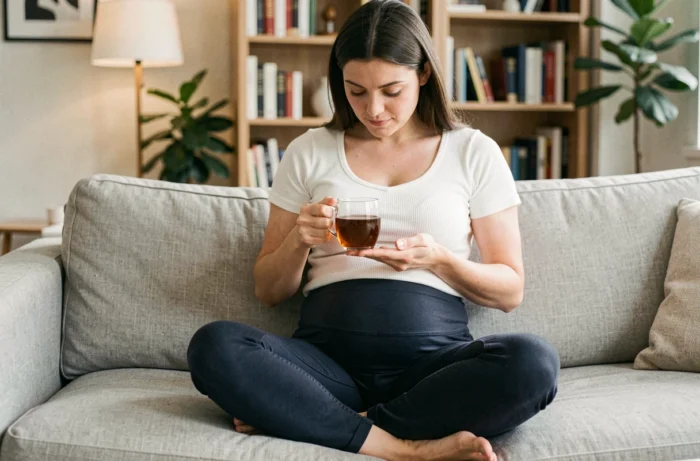
Buying an entire wardrobe for nine months of pregnancy doesn’t make sense. Your body changes quickly, and some pieces will only be useful for a few weeks. The goal is to put together a core collection of versatile basics, complemented by two or three dressier pieces.
Basics that work across all three trimesters
Adjustable-bellyband pants can see you through your entire pregnancy. The band folds down under your belly in the second trimester, then pulls up over it in the third. This simple feature means you don’t have to buy pants in multiple sizes.
Key pieces for a functional wardrobe include:
- Two or three stretch-cotton tops with flat seams that work under a jacket or on their own, and adapt as your bust and belly grow.
- Maternity jeans with a stretchy belly band and a slim fit through the legs for a streamlined silhouette.
- A soft-knit wrap or crossover dress that naturally accommodates your belly without restrictive fastenings and can also work for breastfeeding after birth.
- Thick cotton maternity leggings, opaque enough to wear instead of pants during the day and comfortable enough to sleep in.
Statement pieces that make a difference
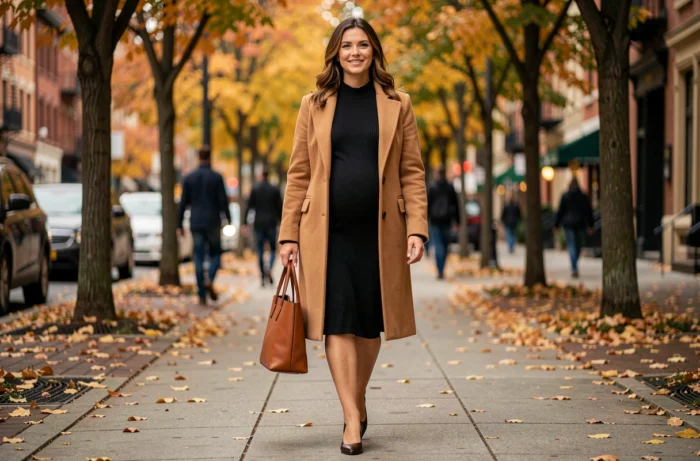
An unbuttoned oversized blazer can turn a simple T-shirt into an office-ready outfit. Non-maternity clothes with straight or flowing cuts can round out your wardrobe at no extra cost. An elasticated midi skirt, a shirt borrowed in a size up, a long cardigan—most wardrobes already have pieces like these.
Looking stylish during pregnancy has less to do with accumulating clothes and more to do with coordinating colors and proportions. A fitted top with a flowing bottom—or the other way around—is all it takes to define your silhouette.
Maternity clothing sizes: stick with your usual size or size up?
It’s tempting to go up one or two sizes. But that often leaves clothes too loose at the shoulders and arms, creating a “sack” effect instead of flattering your bump.
For maternity clothes, your pre-pregnancy size is usually the right one. These garments are designed with stretch panels around the belly and bust. A maternity size 38 corresponds to a regular size 38, with extra room built into the design.
For non-maternity pieces such as shirts, jackets, and flowing dresses, sizing up can make sense, as long as the shoulders still sit in the right place. Clothes that are too big can make your silhouette look shapeless. The right size, with some elastane, will flatter your figure.
Secondhand maternity clothes: a smart way to save
Pieces worn for just a few months are often still in excellent condition on resale platforms, in thrift stores, or in parent-to-parent swap groups. It’s a practical way to add variety to your outfits without buying lots of new clothes.
When buying secondhand maternity clothes online, two checks can make all the difference. First, ask for the exact fabric composition: a sufficient percentage of elastane helps ensure the knit still bounces back after multiple washes. Then, check the fabric’s opacity and drape, especially for dresses and leggings, as fabric that has become see-through or started to pill won’t return to its original condition.
Buying secondhand also lets you try cuts you might not want to buy new—such as a fitted dress or palazzo pants—at a lower cost. If a piece doesn’t work for you, it’s just as easy to resell as it was to buy.
Update your maternity lingerie without compromising on support
Your breasts start changing in the first few weeks, sometimes before your belly is even visible. Continuing to wear a bra that’s become too small can compress the milk ducts and make you more uncomfortable.
An underwire-free bra with flexible cups provides enough support while accommodating changes in volume. Stretch-cotton bras with wide straps distribute the weight more evenly as your bust grows.
For underwear, low-rise styles sit below your belly, while high-rise styles cover it and provide light support. The right choice depends on your trimester and personal preference. Either way, flat seams and breathable fabric help prevent marks on your skin.
Your maternity wardrobe doesn’t need to be large to be practical and stylish. A few well-chosen pieces in natural fabrics, in the right size, with cuts that move with your body rather than restrict it, will cover most everyday situations as well as dressier occasions.