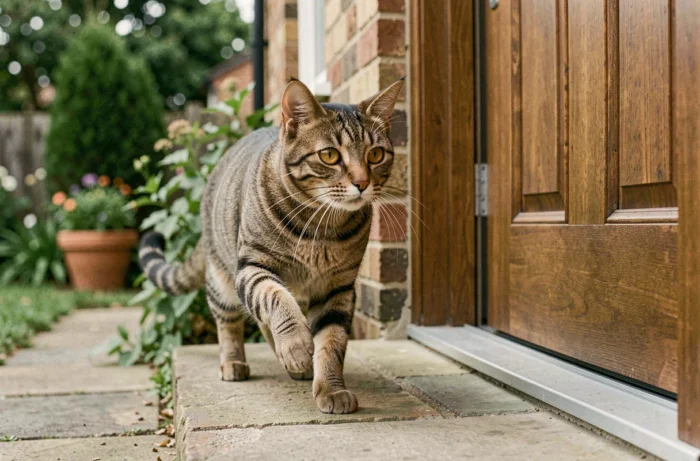
One morning, when opening the door, you come face to face with a cat you’ve never seen before. It returns the next day, then the day after. This scenario is repeating in more and more French households, driven by a constantly increasing population of stray cats. Understanding why an unknown cat comes to your home allows you to adopt the right reaction, whether you want to welcome it or discourage it.
Territorial marking and neighborhood resources: what the cat evaluates before coming
Even before stepping a paw into your garden, a stray or semi-feral cat has mapped its environment. Its territory is organized around hunting areas, resting spots, and water sources. If your house is located on a thoroughfare or at the border of two territories, it becomes a natural landmark.
What concretely attracts the cat is the combination of three elements: a shelter (hedge, shed, under the terrace), an accessible water source (bowl, dripping garden tap), and a lack of predators or dogs in the vicinity. If these conditions are met, the cat includes your address in its patrol routine.
We also underestimate the role of smell. A feline perceives scent trails left by other cats or by food stored inside. A simple bag of kibble placed near a slightly open window is enough to attract it from several dozen meters away. To better understand the motivations of these visitors, a detailed article explains why an unknown cat comes to visit you.

Stray cat, lost cat, or neighborhood cat: distinguishing the profiles
Not all unknown cats that show up at your place are in the same situation. The response to provide changes completely depending on the animal’s profile.
The neighborhood cat on a stroll
This is the most common case. The animal has an owner, a home, but it expands its territory. It is generally in good condition, with clean fur and a healthy weight. It comes to your place out of curiosity or because it has found a quiet spot. Opinions vary on this point, but regularly feeding this cat may divert it from its original home.
The lost or abandoned cat
A thin cat with dull fur that meows insistently at the door is likely seeking help. Shelters and the SPA receive many more cats than dogs each year, with a massive spike in kittens from unwanted litters in spring and summer. This unknown cat in your garden may be a direct product of this demographic pressure.
The stray cat born outdoors
This one has never had a home. It is often more wary, keeps its distance, and only comes for food. Its behavior is markedly different: it does not seek physical contact, it eats, and then leaves.
Here are the clues that help identify the profile:
- A visible collar or a tattoo in the ear indicates a cat with an owner. Also check for the presence of a microchip at a veterinarian
- A well-groomed coat, unworn claws, and a normal weight signal an animal fed elsewhere
- A cat that allows itself to be touched without fleeing has probably been socialized with humans from its first weeks
Proliferation of stray cats in France: a context that explains the frequency of the phenomenon
The reservoir of stray cats in France continues to grow. This demographic pressure explains why the likelihood of seeing an unknown cat appear at home increases year after year, especially in suburban areas.
Insufficient sterilization remains the main driver of this proliferation. An unspayed female cat can have two to three litters per year. Organizations like Chats de l’Ombre are intensifying capture-sterilization-release campaigns, but shelters remain overwhelmed, particularly during the summer months.
Some municipalities are beginning to sign agreements to control the local feline population, jointly funding sterilization programs with organizations. In practical terms, a stray cat that comes to your home is often a symptom of a sterilization deficit in the neighborhood.
Reacting to an unknown cat: concrete actions depending on the situation
The first rule is observation. Before touching the animal, observe its general condition from a distance for a few minutes. An injured cat, one that is limping or has eye discharges, requires prompt veterinary care.
If the cat appears healthy, here’s what to do:
- Do not feed it immediately. If it’s a neighborhood cat, food creates a dependency that complicates its return to its owner
- Check for the presence of a tattoo (ear or inner thigh) and, if possible, have the microchip scanned at a veterinarian
- Contact the town hall and check lost pet notices on local social media or groups dedicated to lost animals
- If no owner comes forward after several days, notify an animal protection organization or the nearest shelter
Legally, you cannot claim a found cat without respecting a waiting period. The animal must be reported, and any potential owner has time to claim it.
Should you discourage repeated visits?
If you do not want the cat to return, a few adjustments are enough. Remove accessible water sources, close off access to shelters (under the terrace, open garage), and avoid leaving food outside. Citrus or white vinegar repellents placed at entry points work with some cats, but their effectiveness varies depending on the individual and the animal’s motivation.
A cat that comes to your home rarely indicates chance. It is the intersection of a favorable environment that you unknowingly provide and a feline demographic pressure that does not weaken. Identifying the profile of the animal and adapting your response remains the most reliable approach, both for the cat and for your peace of mind.