
We open a bag of chips for a snack without thinking too much about it. The problem doesn’t arise with an occasional bag, but when consumption becomes regular, two to three times a week, often in front of a screen.
At this rate, salt, saturated fats, and additives accumulate without us realizing it. Identifying the healthiest chips requires looking beyond marketing labels and examining what is really in the composition.
Frequency of consumption: the true health indicator of chips
Articles about chips compare brands with each other but dodge the question of dosage. A shared bag on Saturday night does not have the same impact as an individual bag nibbled on three nights a week in front of a series.
A portion of classic chips (about one-third of a bag) can represent a significant part of the daily salt intake. If we add bread, cheese, and dip to the snack, the salt quota skyrockets even before the meal.
The at-risk profile is not the one who indulges once a month. It is the regular consumer who piles up sources of salt and saturated fats throughout the week without being aware of it.
Before searching for the perfect brand, it’s beneficial to set a simple framework: how many times a week do we open a bag, and how much is actually consumed each time. To clarify, a detailed comparison helps identify the healthiest chips for health beyond the packaging.
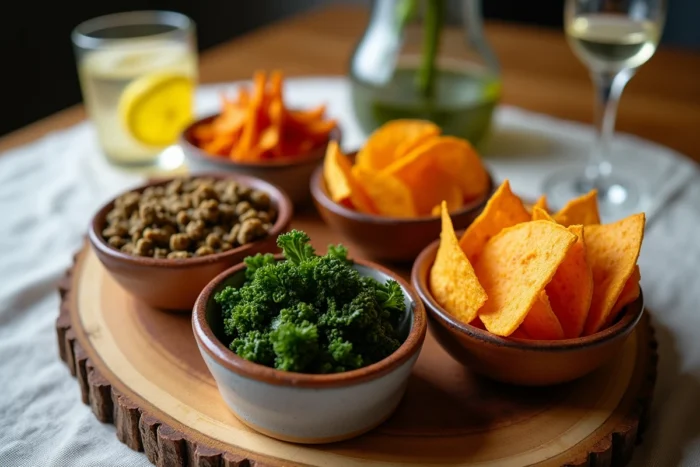
Legume chips and vegetable chips: decoding the health marketing trap
A green bag, a visual of lentils, the mention “source of protein” in large letters: everything leads to believe that we are making a virtuous choice. The nutritional reality tells a different story.
Salt content often higher than classic chips
Some alternative chips contain significantly more salt than the classic version. The differences in salt content between plain chips and those made from grains or legumes can be considerable, making comparison in-store essential.
The OCU analyzed 17 bags of vegetable chips and found that the energy content and fat levels remain very close to those of potato chips. The packaging changes, but not the caloric balance.
More protein does not mean better for health
Chickpea or lentil chips do indeed provide more protein and sometimes more fiber than potato chips. This gain is real. However, it does not compensate for a longer list of ingredients filled with additives, flavors, or excessive salt content.
The practical rule: flip the bag and read the “salt” line first. If it exceeds 1.5 g per 100 g, the nutritional benefit displayed on the front becomes negligible.
Salt, saturated fats, and additives: three criteria for sorting packages on the shelf
The Nutri-Score provides a quick indication, but it aggregates too many parameters to be sufficient on its own. In-store, we save time by focusing on three lines of the nutritional table.
- Salt (g/100 g): prioritize the lowest references. The higher the salt content, the more it weighs on daily consumption, especially if other salty foods accompany the snack.
- Saturated fats: chips cooked in sunflower or olive oil generally contain less than those cooked in palm oil. The mention “oil” on the ingredient list deserves a systematic look.
- Additive list: a classic plain chip often contains three ingredients (potato, oil, salt). When the list exceeds six or seven components, we move into ultra-processed territory, regardless of the vegetable highlighted on the packaging.
Feedback varies on lighter versions: baking sometimes reduces fats but does not guarantee an overall improvement if salt or additives increase in parallel.
Snack alternatives that keep the crunch without the nutritional trap
If we consume chips several times a week, replacing one out of two sessions with a different option has more effect than searching for the perfect chip.
- Oven-roasted chickpeas with a bit of paprika: high in fiber and protein, very low in salt if we dose it ourselves, and the crunch holds up well.
- Fresh vegetable sticks (carrots, cucumber, radishes) with homemade hummus: we control the salt, while keeping the dipping and snacking gesture.
- Homemade thinly sliced potato chips, baked with a spoonful of olive oil: three ingredients, no additives, and a salt level we can manage.
Making it yourself remains the only way to control exactly what we eat. No industrial brand, however well-rated, will score better than the homemade version on all criteria simultaneously.

The choice of the healthiest chips is not about a miracle brand but about a reflex: read the salt line, count the ingredients, and adjust the frequency. A classic plain chip bag with three ingredients, consumed once a week, poses fewer problems than a “healthy” legume chip nibbled every evening. Marketing changes the packaging, rarely the nutritional balance.