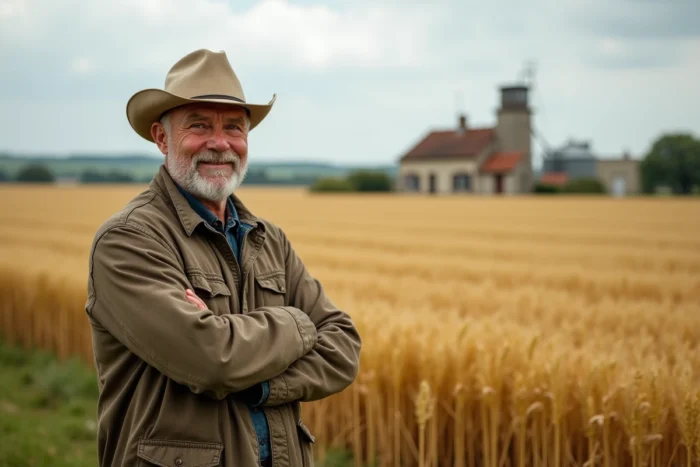
In France, the median agricultural income remains modest, and most farmers derive less than half of their resources directly from their activity. Becoming the richest farmer in the profession requires a radically different economic model from that of a traditional farm. This gap is based on specific mechanisms: asset structuring, vertical integration, and capturing public aids proportional to size.
Agricultural Professional Assets: Why Land Changes Everything
The wealth of a farmer is not measured by their monthly salary. It is reflected in their gross professional assets, which include land, buildings, equipment, livestock, and stocks. According to the 2003-2004 Wealth Survey analyzed by INSEE, farming households hold the largest gross professional assets among self-employed workers, ahead of liberal professions.
Land is the differentiating factor. Farmers accumulate land assets and operating buildings that weigh more heavily than those of artisans or merchants. This concentration of fixed assets creates a well-documented paradox: a farmer can be “rich on paper” while having only a few hundred euros a month to live on. It is precisely this land leverage that the wealthiest farmers exploit differently, making it liquid through suitable legal structures.
To better understand the journey of a wealthy farmer on Club Entrepreneur, one must examine how this land wealth transforms into real financial power when backed by a business strategy.
Agricultural Holdings and Vertical Integration: The Model of French Agricultural Fortunes
The richest farmer in France does not manage a farm in the traditional sense. They run a family or asset-holding company that encompasses several activities: production, processing, marketing, and sometimes even trading in raw materials.
This vertical integration model changes the very nature of income. Instead of selling wheat to an intermediary, the holding captures the margin at every step of the value chain. Crop production feeds a processing subsidiary, which supplies a controlled distribution network. The profit is no longer limited to the gross agricultural margin; it multiplies.
Recent rankings of major professional fortunes in France confirm this trend. Wealth linked to agri-food is increasing, but it is accounted for at the holding level, not the farm level. Agricultural wealth is now measured at the group level, not the field.
Arnaud Rousseau illustrates this logic. President of FNSEA since 2023, he is also the mayor of Trocy-en-Multien and manages a large cereal farm in Seine-et-Marne. He has served on the board of the Avril group, a major player in oilseeds and plant proteins. This dual role (agricultural unionism and governance of a listed agri-food group) shows how a farmer can access financial levers that are unavailable to a traditional cereal farmer.
Public Aids and Large Cereal Farms: An Underestimated Leverage Effect
French and European public aid schemes are often proportional to the cultivated area or the volume of inputs consumed. This principle, rarely discussed from this angle, structurally advantages large farms.
Since 2026, a national emergency plan for nitrogen fertilizers provides aid of up to 70 euros per ton for farmers whose fertilizers represent more than 10% of their expenses, with a ceiling set at half of the 2025 consumption. For a farm of several hundred hectares in large crops, this mechanism represents significant savings on the primary expense item.
The effect is cumulative. A large farm captures more direct aids (CAP, coupled aids to areas), reduces its unit costs through economies of scale, and then reinvests the differential in additional land. This cycle concentrates agricultural wealth in an increasingly restricted number of hands.
- CAP aids are primarily calculated per hectare, favoring the largest farms in terms of area
- Emergency measures on inputs (like the 2026 fertilizer plan) benefit intensive farms with high purchasing volumes
- Subsidized loans and public guarantees are more accessible to structures with significant land assets used as collateral
Land Concentration and Asset Strategy: What Separates a Wealthy Farmer from a Rich Farmer
The dispersion of wealth among farmers is much lower than among liberal professions, according to INSEE data. In other words, the majority of farmers hold assets within a relatively homogeneous range. Those who deviate upwards have made different structural choices.
The first choice is land concentration. Buying neighboring land when a farmer retires, negotiating long-term rural leases, partnering through agricultural civil operating companies (SCEA or EARL) to pool assets: these strategies allow reaching a critical size where fixed costs are diluted.
The second choice is asset diversification outside agriculture. The wealthiest farmers invest part of their profits in rental real estate, financial investments, or stakes in agri-food companies. Wealth does not remain immobilized in land: it circulates between productive assets and financial assets through the holding.
- Creation of a family holding company combining farming, land, and industrial stakes
- Diversification into processing (milling, oil production, packaging) to capture downstream margins
- Investing surplus in non-agricultural assets (real estate, investments) to smooth risks related to commodity prices
The distinction between a wealthy farmer and the richest farmer in France ultimately lies in a shift in posture. The former operates a profitable farm. The latter manages a portfolio of assets where farming is just one component, albeit central, but integrated into a financial architecture that multiplies every euro of margin produced in the fields.