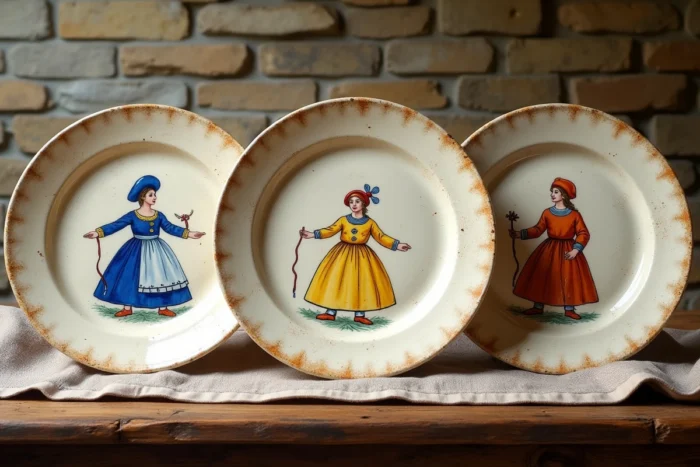
Dating a Henriot Quimper pottery piece relies on a cross-examination of three material clues: the mark on the back, the decorative style, and the technique of applying the glaze. Each production period has left readable traces, provided you know where to look. This guide measures the differences between the main eras to help you locate your pieces without systematically resorting to an expert.
Henriot Quimper Signatures: Comparative Table by Period
The mark applied under the piece remains the primary dating criterion. The factory has modified its signatures several times, and these variations serve as a reliable reference.
| Period | Typical Mark | Characteristics |
|---|---|---|
| Before 1922 | Initials “HB” or simple marks | Letters often hand-drawn, sometimes hard to read, without geographical mention |
| 1922-1968 | “Henriot Quimper” in full | More standardized script, appearance of the full name of the city |
| After 1968 | Modernized marks, sometimes coded | Numeric codes or series added, typography aligned with industrial standards |
| Contemporary labeled production | “HB-Henriot” with EPV documentation | Pieces accompanied by certificates, series traced in internal archives |
A piece bearing only the initials “HB” without mention of “Quimper” indicates a production prior to 1922. In contrast, the presence of the full name “Henriot Quimper” signals the interwar period or the post-war era.
To delve deeper into the analysis of marks and their evolution, an article details how to date a Henriot pottery on Côté Déco based on referenced signatures.
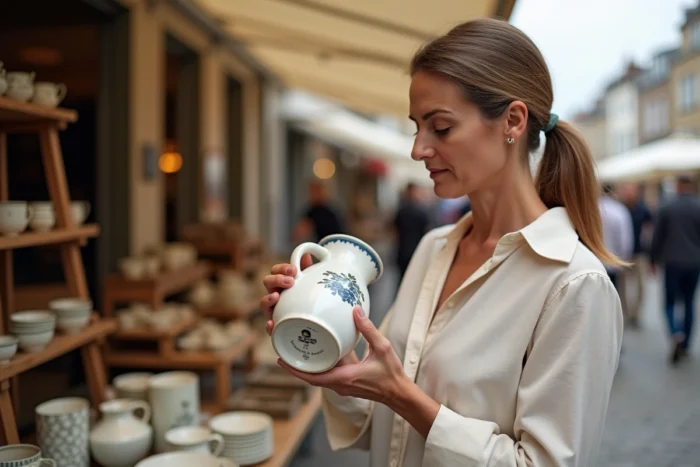
Breton Decor and Color Palette: What the Style Reveals About the Era
The hand-painted decor is the second exploitable clue. Each period of the factory corresponds to distinct aesthetic choices, linked to the artistic influences of the time and commercial demand.
19th Century Decors
In the 19th century, Henriot’s production is rooted in a tradition inherited from the pottery factories of Nevers and Rouen. The motifs incorporate floral elements and popular characters, with a predominance of blues and yellows in high fire. The brushwork is spontaneous, sometimes irregular, characteristic of quick “touch” painting.
The Turning Point of the Early 20th Century
The Belle Époque and the tourist development in Brittany prompted the factory to assert a more typically Breton style. The decor featuring the “Petit Breton” (characters in traditional costume, bigoudènes) becomes emblematic. Floral garlands and color bands become codified.
In contrast, pieces produced in the 1930s show a noticeable Art Deco influence: geometric lines, bolder color blocks, collaborations with artists outside the factory.
Contemporary Pieces and Reissues
Recent collaborations between Henriot-Quimper and decoration or fashion brands introduce palettes and shapes that did not exist in historical production. Modern shapes and partner branding distinguish these series from old pottery. The Breton motif remains present but is treated with contemporary graphic sensitivity, making them easily identifiable.
Stanniferous Glaze and Manufacturing Technique: The Physical Clues
Beyond the decor, the manufacturing technique itself provides dating clues that signatures alone cannot confirm.
- The stanniferous pottery from Quimper uses an opaque tin-based glaze. On old pieces (19th and early 20th century), this glaze often shows slight surface irregularities, drips, or micro-chips related to high fire firings.
- Turned pieces (round shapes like bowls and plates) are distinguished from pressed pieces (oval or rectangular shapes) and cast pieces (hollow shapes). A round shape with traces of manual turning indicates an older artisanal production.
- The first firing of the biscuit and the second firing of the decorated glaze leave specific marks: the traces of pernettes under old pieces are a sign of authenticity often overlooked.
On a contemporary piece labeled Entreprise du Patrimoine Vivant, the process remains manual, but the glaze’s regularity and finish are more uniform. The absence of documentation (certificate, serial number) on a supposed recent piece may indicate an unofficial object or a derived series.
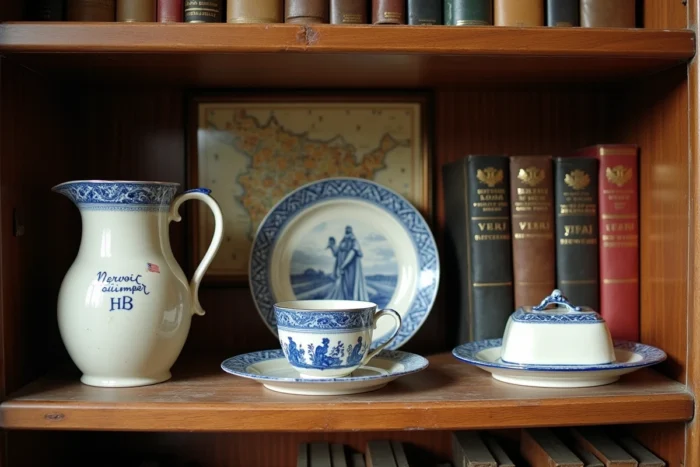
Three Quimper Factories: Do Not Confuse Henriot, HB, and Porquier-Beau
A common mistake is to attribute pieces from the other two major Quimper factories to Henriot. HB (La Hubaudière), Porquier-Beau (PB), and Henriot (HR) are three distinct entities with their own marks and styles.
- The HB factory, located in the Locmaria district, is the oldest. Its marks feature the letters “HB” but in a different graphic style than Henriot.
- The Porquier-Beau factory uses the initials “PB”. Its decors, often more refined, are distinguished by a particular treatment of figurative scenes.
- Henriot, identified by “HR” then “Henriot Quimper”, merged with HB during the 20th century. Pieces produced after this merger bear the dual mark “HB-Henriot”.
Confusing these marks undermines any attempt at dating. The dual signature “HB-Henriot” indicates a piece produced after the merger of the two factories, which excludes dating prior to the 20th century.
Old Henriot Pottery: Common Pitfalls in Resale
The market for Quimper pottery mixes authentic pieces, official reissues, and copies. Some concrete markers help to sort them out.
A piece without any mark on the back is not necessarily old. Some productions from the 19th century were not systematically signed, but the absence of a mark combined with a very regular glaze and a printed decor (rather than hand-painted) almost always indicates a recent reproduction.
The hand-painted decor remains the most reliable marker of authentic Henriot pottery. Variations in brush strokes, slight misalignments between the motif and the border, and color impasto are all evidence of artisanal work. A perfectly symmetrical and uniform motif betrays a mechanical transfer.
The Entreprise du Patrimoine Vivant label awarded to the contemporary factory implies internal documentation procedures. In the secondary market, requesting traceability for a recent piece allows for a quick check to verify if it indeed comes from the official workshops of Quimper.