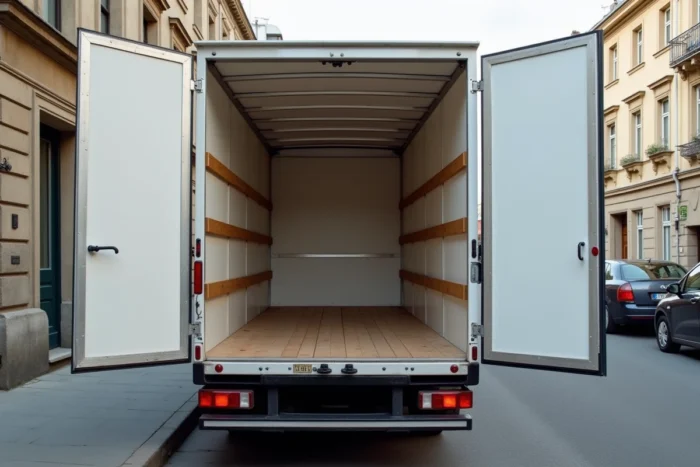
A truck advertised as 10 m3 does not always deliver the same loading space. Depending on the model, the interior length of the cargo area varies by more than 60 cm, the payload ranges from 905 to 1,605 kg, and the ceiling height changes enough to block or allow the transport of a wardrobe. Understanding these discrepancies helps in choosing the right vehicle and avoiding a second trip.
Interior Dimensions and Payload: Discrepancies Between 10 m3 Models
The nominal volume of 10 m3 hides real size differences. Two examples from rental company specifications illustrate the extent of the problem.
| Criterion | Renault Master L1H1 (UCAR) | Large Van 10-12 m3 (Rent A Car) |
|---|---|---|
| Interior Length | 2.58 m | 3.26 m |
| Interior Width | 1.76 m | 1.78 m |
| Interior Height | 1.70 m | 1.84 m |
| Payload | 905 to 1,605 kg depending on version | Not specified (category 10-12 m3) |
The length difference reaches 68 cm between these two cargo areas. In practical terms, a 2.40 m three-seater sofa fits in one and not in the other, despite comparable advertised volume.
On the payload side, the gap is even more pronounced. A Renault Master L1H1 can drop to 905 kg in high-end version, while the same mechanical base rises to 1,605 kg in stripped-down utility version. Loceco, on the other hand, announces 1.4 tons of payload on its 10 m3, an intermediate figure. Before booking, checking the technical specifications of the proposed vehicle (and not just the category) avoids unpleasant surprises at the time of loading.
To learn everything about the 10 m3 truck and its loading variants, the details of possible configurations help to decide between volume and weight.
Payload of the 10 m3 Truck: Volume or Weight, Which Limit to Reach First
The common reflex is to fill the cargo area to the ceiling. For boxes of clothes or books, the weight limit is reached well before the space is saturated. For lightweight furniture (flat-pack shelves, mattresses, chairs), it’s the opposite: the volume fills up while the scale remains far from the maximum.

Loceco explicitly cites tiles, bricks, and concrete among the loads suitable for a 10 m3. These construction materials are heavy per cubic meter. A few pallets of tiles are enough to reach the maximum payload while occupying only a third of the floor space.
- Standard moving boxes (books, dishes): the payload of 1,000 to 1,400 kg fills up with about 60 to 80 boxes, depending on their contents. The volume is then filled only to two-thirds.
- Light furniture and common appliances (double bed, two-seater sofa, washing machine, refrigerator): volume limits before weight. A studio of 20 to 30 m2 fits in a single trip.
- Dense materials (bags of mortar, plasterboard, carpentry): weight becomes the limiting factor very quickly, sometimes as soon as a quarter of the volume is occupied.
Checking the exact payload of the rented vehicle, and not just its volume, is the only way to know how many heavy materials can actually fit.
Types of Loads Possible in a 10 m3 Van
The 10 m3 covers a wider range of uses than just residential moving. Europcar also positions it for deliveries and commercial uses, broadening the typical renter profile.
Moving a Small Home
A studio or a T2, or even a sparsely furnished small T3, is the best-documented use case. The combination of a double bed, two-seater sofa, refrigerator, washing machine, and a few dozen boxes fits in a single trip. The interior height of 1.70 to 1.84 m depending on the model allows for the upright loading of a standard wardrobe, provided the exact height of the reserved vehicle is checked in advance.
Professional Deliveries and Craftsmanship
A craftsman transporting plasterboard, bags of glue, or carpentry uses the flat floor and the width of the 10 m3 without needing a larger truck. CeramikaDrive classifies volumes of 5 to 10 m3 as suitable for this type of material. The payload remains the decisive criterion for these dense uses.
Bulky but Lightweight Items
Mattresses, bike frames, boxes of clothes, flat-pack furniture: these loads fill the space well before approaching the weight limit. In this case, the shape of the cargo area (length and height) matters more than the tonnage.
Optimizing the Loading of a 10 m3 Truck: Distribution Constraints
Filling a 10 m3 is not just about stacking. The distribution of masses affects the vehicle’s handling and safety.
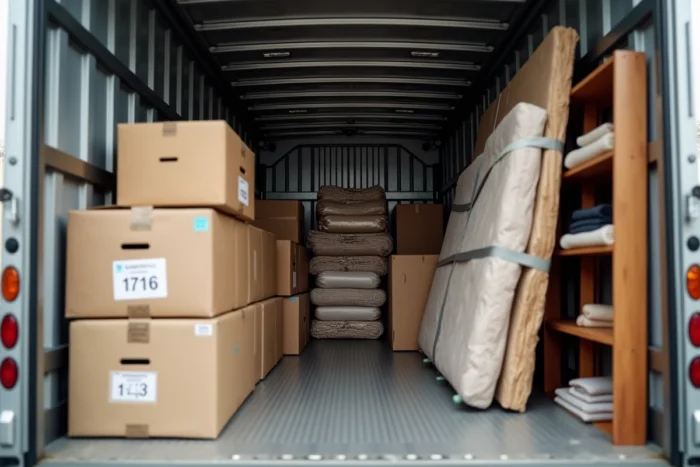
The heaviest items (appliances, boxes of books, construction materials) should be placed at the back of the cargo area, as low as possible and against the partition wall with the cabin. This arrangement lowers the center of gravity and keeps the rear axle loaded evenly.
- Place heavy and compact items first, on the floor, against the cabin partition
- Secure furniture vertically along the side walls to free up central space
- Fill gaps with the lightest boxes and protective blankets
- Ensure that the total weight does not exceed the indicated payload on the vehicle’s technical sheet, not on the rental company’s generic category
A poorly distributed load, even below the weight limit, can cause lateral displacement in turns or increase braking distance. On a front-wheel-drive van like the Renault Master or Fiat Ducato, excess load at the rear unloads the steering wheels and degrades grip.
The key takeaway before any booking is to check: compare the actual payload of the proposed vehicle (between 905 and 1,605 kg depending on the version) to the estimated weight of the load. The volume of 10 m3 is an indicator of space, not a guarantee of transport capacity.