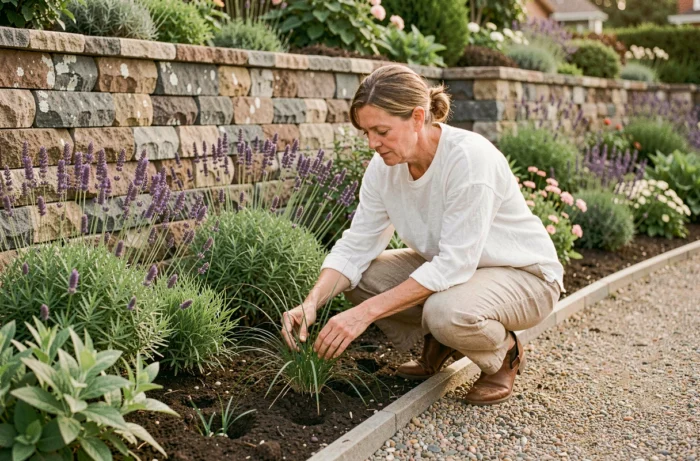
A lasting landscape design relies on the choice of plant vocabulary before that of furniture. We have observed for several seasons that the most successful projects share a common point: they start from the ground, not from the catalog. Understanding the structure of the soil, its exposure, and its water regime allows for the creation of a natural and elegant garden without forcing the palettes.
Substrate and drainage: the technical foundation of a sustainable landscape garden
A planting bed in poorly drained soil will always regress, regardless of the quality of the plants. Before any planting, we recommend a simple percolation test: dig a hole forty centimeters deep, fill it with water, and observe the absorption time. If the water stagnates for more than four hours, alveolar drainage or a bed of crushed gravel beneath the planting layer is necessary.
Successful natural gardens integrate this constraint from the design stage. Rather than bringing in large amounts of topsoil, we work with the existing substrate by amending it with successive layers of compost and fragmented branch wood mulch. This approach promotes microbial life and reduces the need for watering after two seasons.
For a structured project that takes these parameters into account, entrusting the landscaping to L’Herbe sous le Pied allows for calibrating each intervention to the actual pedological context.
Flowering meadow and plant layers: composing an elegant natural design
The flowering meadow has established itself as the signature of the natural garden in France in recent years. It reaches full maturity after two to three years, with a flowering period from March to October. After installation, it requires neither watering nor fertilizer, making it both an aesthetic and functional solution.
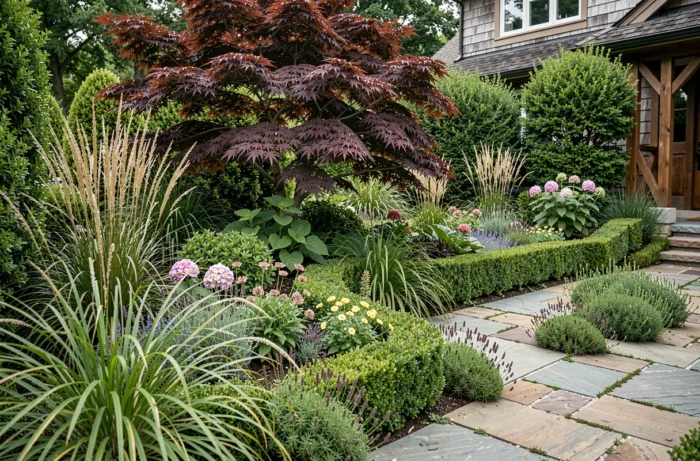
However, a meadow alone is not enough to create elegance. Working with vertical layers adds depth to the space:
- The low layer (ground covers, low grasses, creeping thyme) structures the borders and limits mechanical weeding
- The intermediate layer (tall perennials, ornamental grasses like Miscanthus or Pennisetum) adds movement and filters views without compartmentalizing
- The high layer (lightly branched trees, field maples, serviceberries) creates shade and anchors the composition in the surrounding landscape
This principle of layering, borrowed from forest edges, produces an effect that is both wild and controlled. We recommend limiting the palette to five or six dominant species per layer to avoid a collection effect.
Dry garden and natural stone: the maintenance-free alternative for terrace and courtyard
The dry garden is among the three most requested styles by individuals in France in recent years, alongside the ecological garden and the contemporary garden. Its appeal goes beyond simple water savings: it structures the space with local minerals that age without degrading.
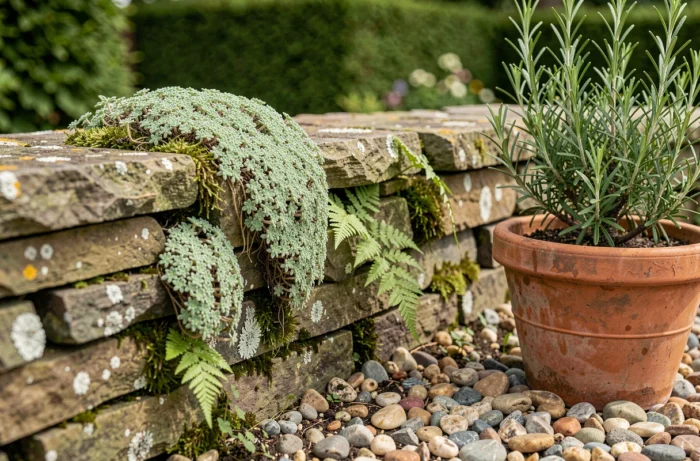
The choice of stone determines the atmosphere. Light limestone laid in opus incertum evokes the Mediterranean garrigue. Dark schist in thick mulch around grasses gives a more northern tone. In both cases, the rule remains the same: use locally sourced stone. The transportation cost is lower, and the visual coherence with the house’s architecture is immediate.
Combining mineral and plant without falling into gravelly
A common mistake is to cover an entire surface with gravel and plant a few lavenders. The result resembles a roundabout. To avoid this pitfall, we work with generous planting pockets, integrated between blocks of stone placed in natural outcrops.
Three to four xerophyte species are sufficient to cover a medium-sized courtyard: agapanthus for verticality, sedums for a low carpet, euphorbias for structural volume, and a grass (Stipa tenuissima, for example) for lightness. The low evening light accentuates the textures and transforms a dry garden into a nighttime scene.
Landscape lighting and water feature staging
Lighting is the most underestimated lever in landscape design. A poorly oriented spotlight flattens a planting bed. A recessed light at the base of a tree with textured bark (birch, Scots pine) creates a shadow that doubles the plant presence.
We favor low color temperatures, around 2,700 kelvins, to maintain a natural ambiance. Cheap LED solar lights often produce a bluish light that distorts foliage. Well-designed lighting extends the garden into the evening without significant consumption.
Water as a compositional element
A formal pond is not the only option. A flush water blade integrated into a wooden or stone terrace creates a mirror that reflects the sky and visually enlarges the space. Closed-circuit wall fountains, powered by a low-power pump, provide background sound without requiring a connection to the network.
Maintenance remains minimal if the water volume is reduced and circulation is constant. A small basin of a few dozen liters with a floating plant (pistia, water lentil) is enough to attract beneficial insects and enhance the garden’s biodiversity.
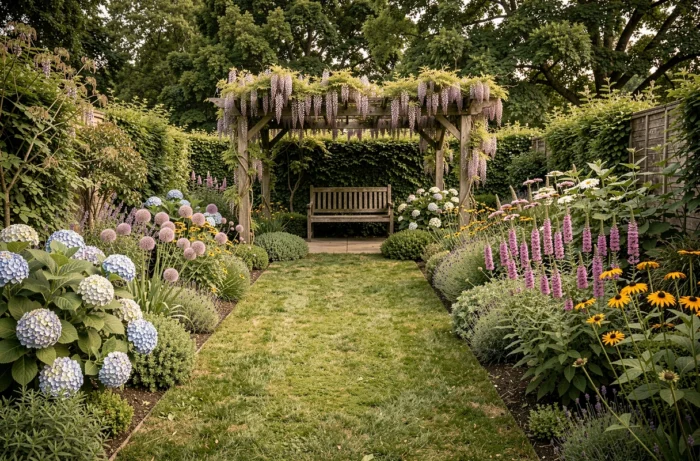
A natural and elegant landscape design is not decreed with a fixed plan. It is built on knowledge of the soil, respect for plant layers, and choices of local materials that age with the place. Gardens that endure through the decades are those where every element, from substrate to lighting, has been conceived in coherence with the site.