
When looking for housing in Brive-la-Gaillarde with children, the first instinct is often to identify schools and parks. The second should be to check if the targeted neighborhood is part of an official zoning that reveals a lot about the local standard of living and public resources deployed. Brive has 23 municipal neighborhoods, and not all are equally suitable for family settlement.
Priority neighborhoods in Brive-la-Gaillarde: what QPV labels reveal to families
The National Agency for the Cohesion of Territories (ANCT) identifies three priority neighborhoods of urban policy (QPV) in Brive: Rivet, Tujac, and Les Chapélies. This label, updated in the new priority geography that came into effect on January 1, 2024, indicates areas where incomes are among the lowest in the municipality.
It would be a mistake to reduce these neighborhoods to a single security indicator. The QPV classification triggers targeted public funding: urban renewal programs, enhanced educational initiatives, and prevention actions. For a family, this means both additional resources in the schools within the area and a more fragile socio-economic reality on a daily basis.
Before signing a lease or a purchase agreement, one can cross-reference the exact address of the property with the QPV mapping available on the ANCT website. An apartment located 200 meters from a priority neighborhood boundary may belong to a completely different environment. Knowing the neighborhoods to avoid in Brive-la-Gaillarde when you have young children helps refine this identification.
Concrete safety criteria for choosing a family neighborhood in Brive
Crime data recorded by municipality can be accessed on open platforms like data.gouv.fr. They provide a general trend but do not always go down to the neighborhood level. To obtain a finer grain, several on-site checks are combined.
- Observe the neighborhood at different times: an evening and weekend visit reveals nuisances (noise, gatherings, poor lighting) that are invisible during a daytime visit
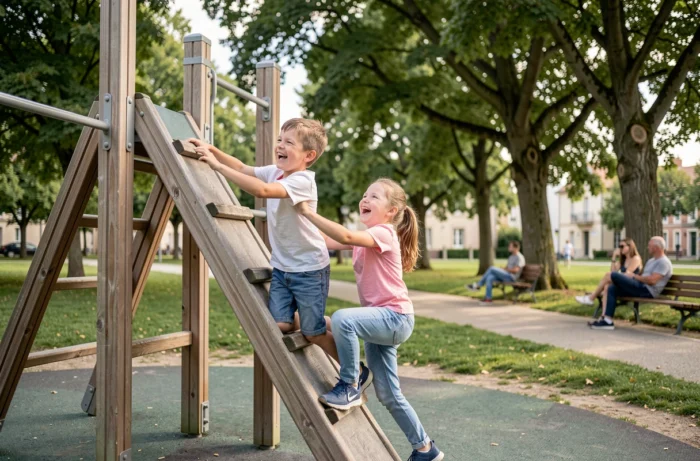
- Identify the presence of nearby facilities frequented by families: well-maintained playgrounds, media library, leisure center open on Wednesdays
- Check the actual walking distance between the housing and the local school, taking into account the terrain (some Brive neighborhoods are steep, complicating trips with young children)
- Ask local shopkeepers and parents at school pick-up, sources of information much more reliable than an online forum
A quiet neighborhood on paper can pose problems if the school is a twenty-minute walk away up a steep hill. The opposite also exists: a sector known for being noisy can offer a residential island very suitable for families as long as you know the right street.
Public lighting and roadways, often overlooked indicators
A wide, well-lit sidewalk separated from the roadway by a clear border is not trivial when pushing a stroller or when a six-year-old walks home. In Brive, some peripheral neighborhoods still lack continuous pedestrian facilities. This point should be checked on-site, not on Google Maps.
Residential areas suitable for children in Brive-la-Gaillarde
Without reproducing the classic list of “popular” neighborhoods found everywhere, we can reason by concrete family use. The decisive criterion is not the prestige of the neighborhood, but the combination of school-safety-daily commutes.
The residential areas located between the city center and the first ring often offer the best compromise. They feature low-traffic residential streets, moderate population density, and quick access to shops without relying on a car for every errand.
School and extracurricular proximity: the first filter to apply
Brive has several school groups spread across the municipality. The city hall website (brive.fr) allows you to check the assigned school based on the address. This point conditions everything else: changing neighborhoods can mean changing schools, which weighs heavily on family organization.
Feedback varies on this point depending on the sectors, but schools located outside QPV generally have more stable enrollments, lower teacher turnover, and a more extensive extracurricular offer (after-school care, canteen, supervised study). This is not an absolute rule, but it is an observable trend.
Real estate budget and geographical arbitration
In Brive, real estate prices remain significantly lower than those in major metropolitan areas. This accessibility allows families not to sacrifice location for space. Prioritizing a smaller home in a well-served neighborhood rather than a large isolated house on the outskirts reduces daily logistical fatigue, especially with young children.
Using the division into 23 neighborhoods to refine your search in Brive
Brive-la-Gaillarde is officially divided into 23 municipal neighborhoods (Arsonval, Bouquet, Breuil, among others). This administrative division, referenced on annuaire-mairie.fr, allows for surpassing the broad vague areas like “south of Brive” or “northern outskirts.”
When contacting a real estate agency or an individual, asking for the exact name of the municipal neighborhood forces the interlocutor to specify the location. One can then cross-reference this name with QPV perimeters, the school map, and roadway data to obtain a reliable portrait of the sector.
The right reflex is to reason at the street level, not the entire neighborhood. Two streets separated by 300 meters in the same neighborhood can offer very different living conditions for a family. No general ranking replaces repeated on-site visits at varied times, notebook in hand.