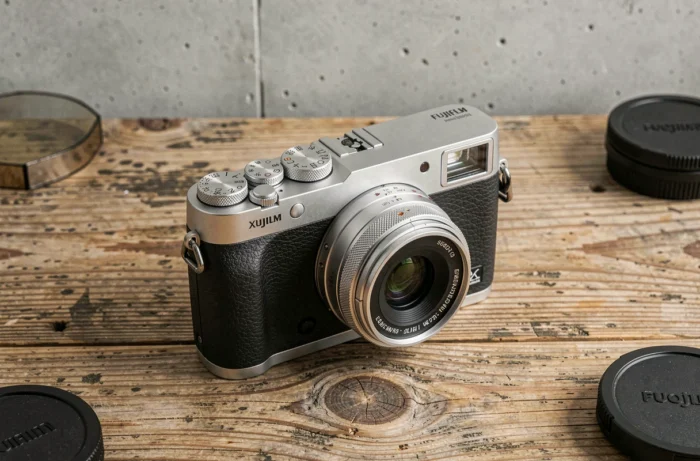
Buying a hybrid camera released more than ten years ago may seem risky. However, the Fujifilm X-E1 is one of those bodies that continues to circulate in the second-hand market, supported by a strong reputation. Its first-generation APS-C X-Trans sensor, compact design inspired by film rangefinders, and X mount compatible with the current Fujinon lens lineup make it a unique item in the entry-level hybrid landscape.
X-Trans I Sensor: What This Camera Really Produces in 2026
Most historical tests describe the X-Trans sensor as a small revolution. The unconventional arrangement of red, green, and blue filters replaces the classic Bayer matrix. The concrete result: almost no moiré without a low-pass filter, preserving fine details.
Have you ever noticed strange patterns on striped fabrics or metal grids in your photos? That’s moiré. The X-E1 eliminates it at the source, where other bodies from the same era rely on an optical filter that slightly softens the image.
One point that older tests could not address: the RAW files from the X-E1 remain compatible with current software. Adobe Camera Raw, Lightroom in their recent versions, and even iOS natively process the RAF files from this camera. So you can shoot with a camera released in 2012 and develop your images on an iPhone or iPad without intermediate conversion. For a second-hand camera at a reduced price, this is a significant argument.
Those who want to delve deeper will find in the Fujifilm X-E1 test a detailed analysis of the outputs in real conditions.
Fujifilm Film Simulations: Asset or Limitation on the X-E1

Film simulations have become one of Fujifilm’s flagship arguments. Provia, Velvia, Astia: these color profiles reproduce the rendering of famous film stocks. The X-E1, as a first-generation X-Trans body, offers a more limited selection than recent models.
Community film recipes do not all work on this body. Profiles created for X-Trans IV or V sensors (those of the X-T4, X-T5, or X100VI) exploit parameters absent from the X-E1. Specifically, if you follow a recipe tutorial found online, make sure it specifically targets the X-Trans I. Otherwise, the colors obtained will not match the expected result at all.
That said, the simulations available on the X-E1 remain usable and true to Fujifilm’s identity. Velvia boosts landscape saturation, Astia softens portraits. For a photographer shooting in JPEG who wants a polished look without post-processing, the result holds up well.
Electronic Viewfinder and Ergonomics: What Ages Well (and Less Well)
The electronic viewfinder of the X-E1 displays a decent resolution for its time. Compared to a hybrid optical viewfinder like that of the X-Pro1, it simplifies aiming by showing the final exposure directly. But compared to the OLED viewfinders of current bodies, the refresh rate seems slow and the rendering lacks fluidity in low light.
Ergonomics, on the other hand, age quite well. Three elements deserve to be highlighted:
- The shutter speed dial on the top of the body allows you to adjust exposure without taking your eyes off the viewfinder, just like on a film camera
- The aperture ring on Fujinon lenses offers direct and tactile control, without going through a menu
- The compact format of the body makes it easy to slip into a bag, much more discreet than an APS-C DSLR from the same period
The main weak point remains the autofocus. Accurate in good lighting conditions, it becomes hesitant as the scene darkens. For posed portraits or landscapes, there’s no problem. For fast action or street photography at dusk, manual focus with focus peaking will often be more reliable.
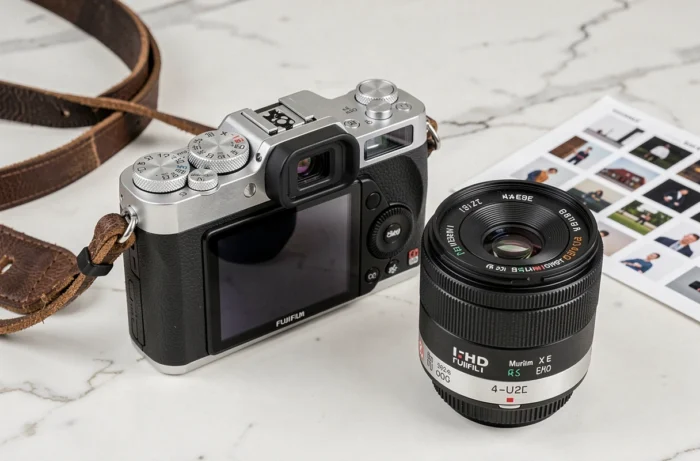
Buying a Second-Hand Fujifilm X-E1: Points of Caution
The X-E1 is now available at very accessible prices on the second-hand market. Before you give in, a few checks are necessary.
- Check the number of shutter actuations: a little-used body will have a shutter mechanism in better condition
- Inspect the sensor for dust or persistent spots, visible in a shot taken at a closed aperture against a plain background
- Test the electronic viewfinder for any dead pixels, a common defect in older bodies
- Ensure that the hot shoe and contacts are clean, especially if the body has been stored for a long time without protection
One of the major advantages of the X-E1 is its compatibility with the entire Fujinon lens lineup in X mount. A lens purchased for this body will work on a X-T5 or X-S20 if you upgrade later. The investment in lenses is never wasted.
Fujifilm X-E1 Against Competing Second-Hand Hybrids
In the same price range on the second-hand market, the X-E1 encounters bodies like the Sony A5000 or the Panasonic Lumix G7. Each has its strengths. The Sony focuses on extreme compactness and more responsive autofocus. The Lumix G7 offers 4K video, which is absent from the X-E1.
The Fujifilm maintains an advantage in two areas: color rendering directly in JPEG and build quality. The body conveys a sense of solidity that its plastic competitors do not provide. For a photographer who prioritizes still images and the pleasure of handling, the X-E1 remains a relevant choice even against newer alternatives.
The second-hand market sometimes offers pleasant surprises with kits that include a Fujinon lens. A X-E1 body paired with a 35mm f/1.4 constitutes a versatile set for street photography, portraiture, and light reportage, all for a budget that few new hybrids can approach.