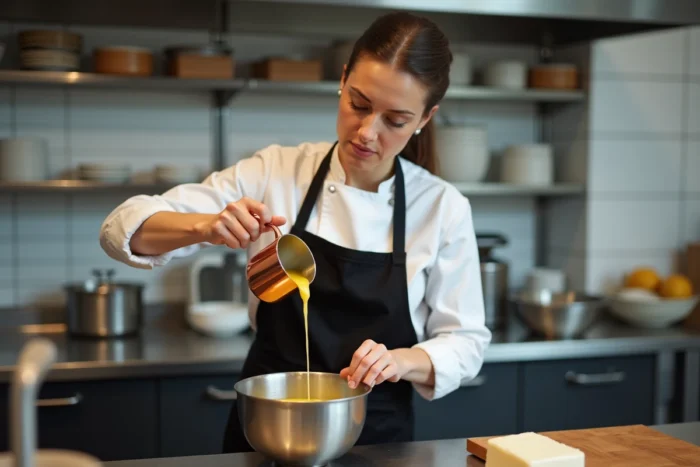
When whipping egg yolks with a hot sugar syrup, the margin between a successful pâte à bombe and a breeding ground for bacteria is just a few degrees and a few minutes. This basic preparation in pastry, used for mousses, entremets, and parfaits, carries several health risks that the lab routine may overlook.
Pâte à bombe and pasteurized egg products: the game-changing choice
In pastry labs, eggs are often cracked by habit. The problem is that raw egg yolk remains one of the most common vectors for salmonella. Even a fresh egg, category A, can harbor the bacteria without visible signs.
The HACCP recommendations applied in pastry now point towards a more reliable alternative: using liquid pasteurized egg yolks instead of shell eggs for sensitive preparations like pâte à bombe, mousses, or tiramisu. Pasteurization eliminates pathogens beforehand, and it also improves traceability, as each batch carries a use-by date and an identifiable number.
On this subject, one can consult Madame Gertrude’s advice, which details the regulatory obligations specific to this preparation. Switching to pasteurized egg products does not alter the texture or volume of the pâte à bombe, provided that the amount of sugar in the syrup is slightly adjusted.
Sugar syrup temperature: the critical point not to improvise
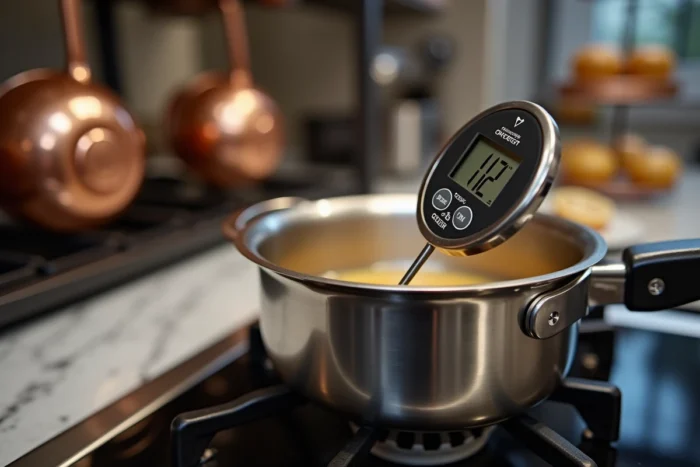
The cooking of the syrup is the moment when everything is at stake. If the syrup does not reach a sufficient temperature, it does not cook the yolks enough to neutralize the bacteria. If it’s too hot, it coagulates the proteins and gives an irretrievable grainy texture.
The probe thermometer is not an accessory; it is a food safety tool. It is immersed in the syrup, and we wait for it to reach the temperature prescribed by the recipe before pouring it in a steady stream over the yolks being whipped. Visual cues alone (bubbles, consistency) are not enough to guarantee proper cooking.
Two common mistakes occur frequently in the lab:
- Pouring the syrup too quickly over the yolks, which creates clumps of cooked sugar instead of a homogeneous mass. The stream should be steady, poured along the edge of the bowl while the mixer is running at medium speed.
- Stopping the whipping too soon after incorporating the syrup. The mixture must cool while being whipped until it reaches room temperature to stabilize the structure and limit the time spent in the thermal danger zone.
- Neglecting to clean the thermometer between uses, which introduces a risk of cross-contamination between the boiling syrup and the finished mixture.
Sanitary control plan: declaring pâte à bombe as a sensitive step
In many laboratories, the PMS (Sanitary Control Plan) lists pastry creams and ganaches as critical points but overlooks pâte à bombe. This is a gap. This preparation ticks all the boxes of a sensitive step in HACCP logic: high-risk raw material (egg), partial thermal treatment, and storage before use in an entremet.
Declaring pâte à bombe in the PMS involves three documented controls:
- Control of the syrup temperature with a thermometer, with a written or digital record at the moment of pouring over the yolks.
- Control of the mixture temperature after whipping, to ensure it has cooled below the bacterial proliferation threshold before storage or incorporation.
- Setting a short internal use-by date for any pâte à bombe stored cold before use. This preparation should not be kept in the refrigerator for several days without documented justification.
Feedback varies on the exact shelf life, but the principle remains the same: the shorter the internal use-by date, the better the health risk is controlled.
Workstation hygiene during preparation
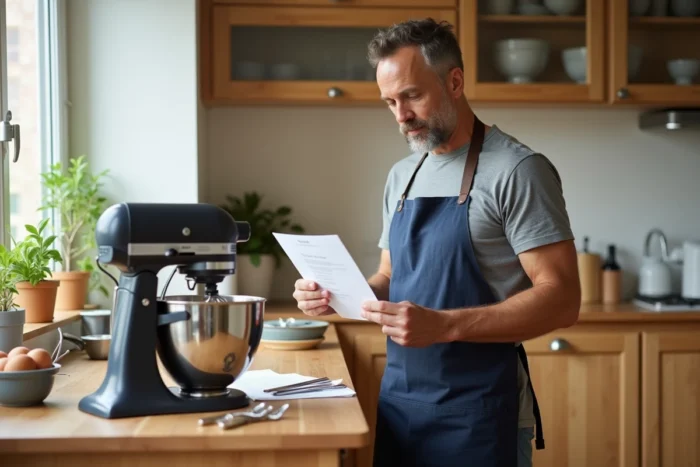
Pâte à bombe is often prepared alongside other elements (cake in the oven, cream cooling, fruits being cut). This multitasking creates opportunities for cross-contamination that are often underestimated.
Some concrete reflexes make a difference. Work with a clean, dry mixing bowl, never a container that has just been used for something else. Utensils that come into contact with raw egg do not touch the finished mixture. The mixer whisk, the syrup pouring spatula, and the storage container are three distinct items.
The work surface around the mixer must remain clear. Egg shells (if shell eggs are used after all) go straight to the trash, not into a bowl placed next to it. Any splatter of raw egg white or yolk on the edge of the mixing bowl contaminates the preparation when scraping it with the spatula.
Cold storage after preparation
Once the pâte à bombe is ready, cover it with cling film directly and place it in the refrigerator without delay. A quick transition to positive cold limits bacterial proliferation in the ambient temperature zone where microorganisms multiply the fastest.
If the pâte à bombe is intended to be incorporated into a chocolate mousse or an entremet mixture, it should be used right away while still warm to facilitate mixing with the whipped cream. Waiting for it to cool completely and then reheating it later is a bad practice: each temperature rise without complete cooking restarts the risk cycle.
Pâte à bombe and food safety: what distinguishes the amateur from the professional
The difference between an amateur pastry chef and a professional in this preparation does not lie in the technical gesture. It lies in documented rigor. The professional notes their temperatures, identifies their batches of egg products, respects an internal use-by date, and can prove, in the event of a health inspection, that each step has been controlled.
For a self-taught candidate for the CAP pastry or a passionate home cook preparing entremets, the same principles apply on a smaller scale. Thermometer, fresh eggs or pasteurized egg products, rapid cooling: these three points are enough to reduce the risk to an acceptable level, even without a formal PMS.
Pâte à bombe remains an accessible preparation as long as the egg yolk is treated for what it is: a sensitive product that does not tolerate thermal approximation.